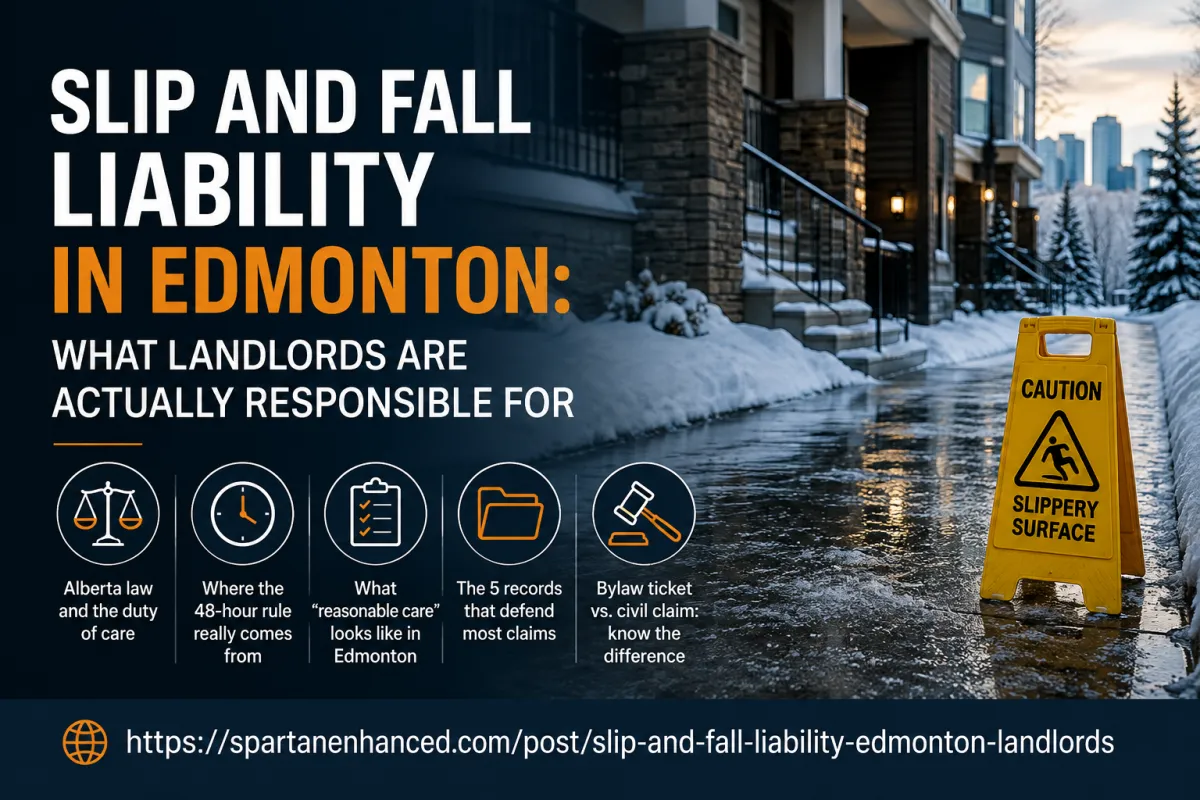
Slip and Fall Liability Edmonton: A Landlord's Guide
If a tenant, a delivery driver or a visitor slips on ice at your Edmonton rental, the claim usually lands on you. Not the tenant. Not, on its own, the contractor you hired. Alberta's Occupiers' Liability Act puts the duty on whoever controls the property, and control is not something you hand off with an invoice.
Here is what that duty means on a real property, where the 48 hour rule actually comes from, and the paperwork that settles most of these disputes.
Who is legally responsible for a slip and fall at an Edmonton property?
The occupier is responsible. Section 5 of Alberta's Occupiers' Liability Act says an occupier owes every visitor a duty to take such care as is reasonable in all the circumstances to see that the visitor will be reasonably safe using the premises. On most Edmonton rentals, that occupier is the landlord or the property manager.
The Act defines an occupier broadly. It covers anyone in physical possession of the premises, and anyone with responsibility for and control over the condition of the premises, the activities on them, and who is allowed to enter. More than one party can be an occupier of the same building at the same time.
In a multi-family building that distinction does real work. Common property such as entry stairs, shared walkways, the parkade ramp and the public sidewalk out front stays with the landlord or the condominium corporation. A single family rental where the tenant holds the whole lot is a different argument, but the lease has to say so, and a court looks at who had real control rather than at what the paperwork claims.
Trespassers are treated differently, and the standard drops to wilful or reckless conduct. That exception does almost nothing for a landlord, because tenants, their guests, delivery drivers, trades and prospective renters are all visitors.
This is why ice control and sanding in Edmonton is better understood as risk management than as a seasonal nice to have.
What reasonable care means when it is minus 25
Reasonable, not perfect. Alberta courts have held repeatedly that the Act does not make an occupier an insurer of every visitor's safety, and that no occupier must take every conceivable precaution. What it does require is a system matched to the risk, running consistently, with evidence that it ran.
Reasonable care on an Edmonton property has four moving parts: an inspection schedule, a defined trigger for service, a response window, and a record of each visit. Miss one and the other three get harder to rely on.
Freeze thaw is where most local claims are born. Afternoon sun melts the snowbank beside the walkway, meltwater runs across the concrete, and by six there is clear ice on a surface bare at noon. Nobody plowed anything wrong. The site just was not checked again.
Signs alone will not save you. The Act is explicit that a warning by itself does not discharge the duty unless it is enough to keep the visitor reasonably safe. A caution sign on an icy stair is not enough. Sanding the stair is.
The 48-hour rule is not in the bylaw
Edmonton's Community Standards Bylaw 14600 sets no deadline for clearing snow. Section 7 requires that a person maintain any sidewalk adjacent to land they own or occupy clear of all snow and ice, and that is the whole requirement. The City's own guidance asks owners to clear as soon as possible, and failing to do so can bring a $100 fine plus the cost of the City clearing it for you.
The 48-hour figure has been repeated so widely here that most owners assume it is law. Treating it as a deadline is a mistake in both directions.
If you are late by the bylaw's actual standard, you are exposed sooner than you think. And inside 48 hours you still have no safe harbour, because a civil claim is measured against what a reasonable occupier would have done in those conditions, not against a clock. Ice that forms at four in the afternoon and injures someone at ten that night does not care that you believed you had 38 hours left.
The enforcement side is worth understanding separately, and we cover the ticketing process and fines in our breakdown of Edmonton sidewalk bylaws and your liability.
A bylaw ticket and an injury claim are two different problems
Clearing a bylaw ticket does not clear a lawsuit. The two run on separate tracks with different triggers, different tests and very different price tags. Owners focused only on avoiding the fine tend to build exactly the thin record that loses a civil claim.
Bylaw enforcement | Civil claim | |
|---|---|---|
Who brings it | A City bylaw officer, usually after a complaint | The injured person, through their lawyer |
What triggers it | An uncleared surface | An injury |
The test | Was the snow and ice cleared | Was your care reasonable in the circumstances |
Typical cost | $100 fine plus City clearing costs | Legal defence, settlement and a higher renewal premium |
Best defence | Clear it | Documented, consistent, dated service |
The second column is the expensive one. A defended slip and fall claim in Alberta runs well past anything a bylaw officer will hand you, and your renewal follows the claim rather than the ticket.
The five records that decide a slip and fall claim
These claims are settled on documents, not memories. Insurers and plaintiff counsel both start from the same question: what can you prove about the condition of the surface and what was done to it. Five records carry most of that weight.
A site map with priority zones. Mark every entrance, stair, ramp, walkway and accessible stall, then rank them. A map dated before the season shows you assessed the risk rather than reacted to it.
Time-stamped photos, before and after each visit. The photograph has to show the surface. A picture of a truck in your lot proves that a truck was in your lot.
A service log for every weather event. Time the snow stopped, time the crew arrived, what was cleared, what product went down, temperature at the time, and when the next check is scheduled.
The contract itself. Trigger depth, response window, scope and what is billed as an extra, in writing and signed. A verbal arrangement is evidence of nothing.
Certificates of insurance and WCB coverage for every contractor on the site. Collect them before the first snowfall, not after the incident.
Most of this is a byproduct of running the service properly. Crews doing sidewalk clearing in Edmonton on a defined schedule generate the log as they go.
How to build a snow and ice log that holds up
A log is only useful if it is continuous. Gaps read as neglect, so record the dry days too. An entry reading site checked 07:15, surfaces bare and dry, no action required does real work if someone falls three days later.
Keep it simple enough that a crew will actually fill it in. Date, time on and off site, zones serviced, material used, surface condition on arrival and departure, weather, and who made the entry. Attach photographs to that entry.
Two habits cause most of the damage. Backfilling a log at month end from invoices is obvious to anyone reading it. Logging only plow visits and skipping ice checks leaves a written record showing you never looked at the surface between storms.
Where Edmonton landlords get caught out
The shoulder season. October and April produce ice nobody is watching for, because the contract has not started or has already ended.
The last ten metres. The lot is cleared curb to curb and the strip between the stall and the door is untouched.
Corner lots. Both sidewalks are yours, and the second one is the one that gets missed.
Vacant units. No tenant means no complaint, and the entrance glazes over until a showing.
Handshake arrangements. A neighbour with a quad leaves you no log, no certificate and no contract.
Snow storage in the wrong spot. A pile draining across a walkway rebuilds the hazard every afternoon for four months.
Hold more than one building and a single documented standard across the portfolio stops being paperwork and starts being cheaper. It is a core part of what professional Edmonton property management is supposed to deliver on winter risk.
Frequently asked questions
Does Edmonton's bylaw give landlords 48 hours to clear a sidewalk?
No. Community Standards Bylaw 14600 requires sidewalks adjacent to your land to be kept clear of snow and ice and sets no time limit. The City asks owners to clear as soon as possible, and failing to do so can bring a $100 fine plus the cost of the City clearing the walk.
Can a lease make the tenant responsible for snow clearing?
A lease can assign the task, and in a single-family rental where the tenant holds the whole lot that clause carries weight. It does not remove your status as occupier over common property, and it will not help you in a multi-unit building or where you kept control of the grounds in practice.
Does hiring a snow contractor remove my liability?
No. It adds a second party who can be named, and a contract with indemnity and current insurance certificates can shift the financial exposure. Owners and contractors are routinely sued together after a fall, so you still need your own records.
How long does someone have to sue after a slip and fall in Alberta?
Generally, two years from when the claim was discovered under Alberta's Limitations Act, with a ten year outside limit. That is why logs and photos need keeping for years rather than months. A file deleted in spring is not available when a statement of claim arrives.
Is sand enough, or do I need a chemical de-icer?
Sand gives traction but melts nothing, so it keeps working below the effective range of common de-icers. Chemical products break the ice bond but lose effectiveness as temperatures drop. Most Edmonton sites run a blend and reapply through freeze thaw cycles.
None of this is about clearing snow faster than the building next door. It is about answering one question in writing, months later: what did you do, and when. Owners who can answer tend to settle small. Owners who cannot tend to settle large.
This article is general information about Alberta occupiers' liability and Edmonton bylaws, not legal advice. For a specific incident, speak with an Alberta lawyer.
Spartan Enhanced runs documented snow and ice programs across Edmonton with timestamped photo verification on every visit. Call 780-935-9243 or email [email protected] to have your site walked before the first snowfall.