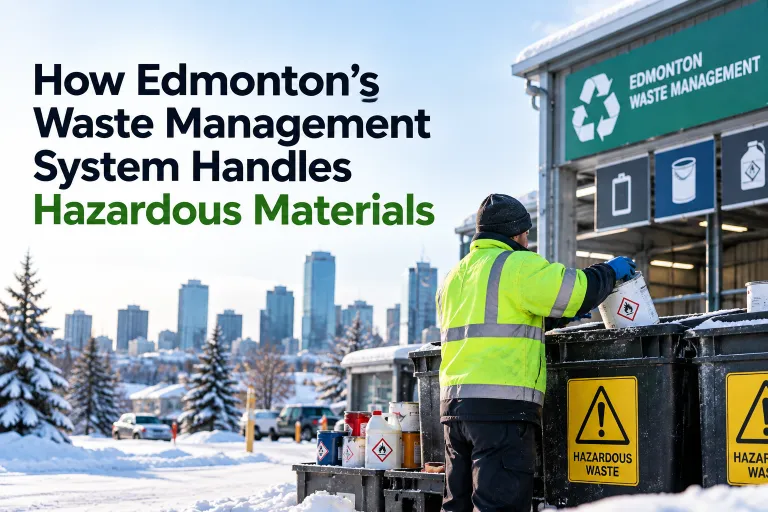
How Edmonton Handles Hazardous Waste | Landlord Guide
Edmonton handles hazardous waste through a split system. Residents drop household hazardous waste at the City’s Eco Stations for free. Businesses mostly cannot. Behind the counter, Alberta’s producer-funded recycling programs took over much of the collection and processing in April 2025, and the final phase of that rollout landed on October 1, 2026.
For anyone managing rental property, the split is where mistakes happen. The leftover paint, cleaners and batteries in a vacated suite can sit on the business side of the line, even though the same items from a tenant’s own home would be accepted without a fee. This guide explains how the system works and where landlords and property managers need to ask extra questions.
Key takeaways
|
What counts as household hazardous waste in Edmonton?
The City defines household hazardous waste as unwanted poisonous, flammable, corrosive or reactive substances from homes, the kind of material that poisons the environment if it is buried in a landfill. Eco Stations accept the following from residents, with liquid containers capped at 20 L (City of Edmonton household hazardous waste):
Automotive fluids: motor oil, oil filters, antifreeze, brake and transmission fluid, gasoline, diesel, rust remover.
Batteries: all of them, including household, computer and car batteries.
Chemicals and cleaners: bleach, drain, toilet and oven cleaners, pool and hot tub chemicals, spot removers, carpet cleaners, photo chemicals, glues and adhesives.
Paint and stains: household paint, wood stains, varnish, paint thinner and spray paint.
Pressurized containers: propane bottles and tanks up to 35 lb, fire extinguishers and aerosol cans.
Anything with a battery or cord: small and large appliances and electronics, including vape devices.
Biomedical waste and radioactive waste are not accepted. Drop-off is free for residents, except for appliances that use refrigerants, which carry a $21 per item fee for refrigerant removal. Eco Station winter hours began on November 2 in 2025 (Tuesday to Saturday, 9 am to 5 pm), so confirm the current season’s hours on the City’s Eco Station page before you load a truck.
What happens after the drop-off?
The City does not publish an item-by-item processing breakdown on its household hazardous waste pages, so here is what the public record does show. The Edmonton Waste Management Centre also processes e-waste, construction and demolition waste and biosolids. The City’s stated reason for keeping e-waste and chemicals out of the landfill is toxic leachate: e-waste contains metals such as lead, mercury and cadmium that harm the environment if buried.
Reuse is built in for one category. The City’s paint exchange lets residents drop off and pick up usable paint free of charge, so a half-full can of neutral beige can end up on another household’s wall instead of in a processing stream.
Fire is the problem the City talks about most. Batteries, it says, “should never go in the garbage” because they cause fires at the Edmonton Waste Management Centre, and rechargeable devices with sealed batteries carry the same risk. During a turnover, a dead smoke alarm or a cordless drill with a battery still inside can easily end up in a garbage bag.
Who runs the system now? Alberta’s producer-funded switch
Alberta’s Extended Producer Responsibility Regulation came into force on November 30, 2022. The programs launched on April 1, 2025 for packaging and paper products and for hazardous and special products, and the final phase took effect on October 1, 2026, expanding recycling to more communities, including some apartments, condos and multi-family homes (Government of Alberta).
HSP covers consumer-sized products that are flammable, corrosive or toxic, including batteries and pesticides. Since April 1, 2025, Product Care Recycling has been responsible for HSP collection and management in Alberta (Product Care Recycling). The program’s published rules say liquids must be 10 L or less, products must be in the original container with the original label, and paint is not part of HSP. Paint stays under the Alberta Recycling Management Authority paint program.
Those details matter in a rental. A labelled bottle of drain cleaner fits the stream. A decanted jar of unknown liquid, or a commercial-size pail, may not.
Where do landlords and property managers fall in the system?
The City’s household hazardous waste page is blunt: Eco Stations are only for residential waste, and commercial clients with hazardous waste, batteries and e-waste must find alternate options, such as Call2Recycle. Its Eco Station fee page adds that businesses, including junk removal companies, can drop off waste at the same fees as residents, with exceptions. One of those exceptions runs the other way: household hazardous waste in the new HSP stream can be dropped off by commercial customers.
So two City pages give two slightly different messages. The page also says Eco Station attendants have final say about accepted items and fees. The City does not say how it classifies an owner clearing a vacant suite, so treat suite cleanout waste as business waste unless the Eco Station or 311 tells you otherwise. A two-minute call beats a rejected truckload.
Item found in a suite | What the City says for residents | If it comes from a rental or business |
|---|---|---|
Batteries (household, computer, car) | Accepted free | City says commercial clients must use other options such as Call2Recycle |
Paint, stain, thinner | Accepted free, containers up to 20 L; free paint exchange for usable paint | Business hazardous waste is not accepted, and paint sits outside HSP. Ask the attendant first |
Cleaners, solvents, aerosols in original labelled containers | Accepted free | HSP stream is open to commercial drop-off. Keep liquids to 10 L or less with original labels |
Propane tanks (35 lb max), fire extinguishers | Accepted free | Same business caveat. Confirm before loading |
Welding and oxygen tanks | Not accepted | Return to point of purchase or use a commercial hazardous waste vendor |
Light bulbs and tubes | Accepted free | 50 cents per CFL and $1 per tube for businesses |
Fridges, freezers, air conditioners, dehumidifiers | $21 per item for refrigerant removal | Same fee. See our appliance disposal guide |
Tires | Free, up to 8 per day | Not accepted from businesses |
What about hazards that are not on the household list?
Biomedical waste is on the City’s not-accepted list, which matters for hoarding and neglect cleanouts where sharps and contaminated materials turn up. Those jobs belong with trained crews, not a pickup and a pair of work gloves. Our guides to how hoarding cleanup works in Edmonton and biohazard cleanup costs in Edmonton explain what the process involves.
Business-generated hazardous waste also falls under provincial law. Alberta regulates it through the Environmental Protection and Enhancement Act and the Waste Control Regulation. Anyone who generates, collects, transports or receives hazardous waste must register for a Personal Identification Number (PIN), which is free, and shipments must travel with a hazardous waste manifest (Government of Alberta). Whether a landlord’s volumes trigger those requirements is a question for Alberta Environment and Protected Areas. Using a hazardous waste vendor that handles the paperwork is one practical way to avoid getting it wrong.
A safe process for clearing hazardous items from a vacated suite
Check notice and storage rules before touching a tenant’s belongings. Our guide to abandoned tenant belongings in Alberta covers what you can and cannot dispose of.
Photograph and list everything before moving it. The inventory protects you in a deposit dispute.
Keep products in their original containers and never combine chemicals.
Pull batteries out of devices and bag them separately. Municipal programs such as Beaumont’s direct damaged, leaking or swollen batteries to a hazardous waste facility, not a collection bin.
Sort the pile into three groups: items a resident could drop off, items that need a business route, and ordinary garbage.
Call the Eco Station or 311 before taking any business load of chemicals, paint or batteries.
Keep receipts and photos from every disposal trip. They show the hazardous items went where they should.
Nothing hazardous goes in the building dumpster. A battery or aerosol can in a compactor is the kind of small mistake that turns into a fire. For routine turnovers, our suite turnover checklist for Alberta landlords builds this sorting step into the workflow.
Why does illegal dumping make this a bigger issue now?
Bad disposal habits have a growing price tag. The City says large items left beside a dumpster will not be picked up and become the property owner’s responsibility to remove, along with the cost (City of Edmonton). On September 30, 2026, Premier Danielle Smith announced legislation that would allow fines of up to $100,000 for individuals and $1 million for corporations. It is not law yet, and the legislature reconvenes on October 27, 2026 (Global News). Edmonton logged more than 600 complaints over five years about dumping on private property and issued 240 tickets, according to the same report.
If a suite cleanout includes chemicals, batteries or anything you cannot classify, a professional crew is safer than guessing. Spartan Enhanced handles junk removal in Edmonton, including eviction cleanouts and appliance and e-waste disposal. If you manage several properties, our Edmonton property management team can fold disposal into a standing maintenance plan.
Frequently asked questions
Can I take paint to an Eco Station in Edmonton?
Residents can drop off household paint, stains, varnish, thinner and spray paint at no charge, in containers up to 20 L. Usable paint can go to the paint exchange. Paint from a business or rental turnover is a gray area, so ask the attendant first.
Can landlords use Edmonton Eco Stations?
Partly. The City says hazardous waste from businesses is not accepted, but items in the HSP stream can be dropped off by commercial customers, and businesses can drop off other accepted waste at the standard fees. Attendants have final say, so confirm before you load.
What happens if batteries go in the garbage?
The City says batteries put in garbage can ignite or explode and do cause fires at the Edmonton Waste Management Centre, putting collectors and processing staff at risk. Take every battery to an Eco Station, or use a commercial option such as Call2Recycle for business loads.
Does Edmonton collect household hazardous waste at the curb?
No. The City collects food scraps, garbage, recycling and yard waste at the curb. Hazardous waste, batteries, electronics and renovation waste go to Eco Stations.
How much does hazardous waste disposal cost in Edmonton?
Drop-off is free for residents, except appliances that use refrigerants, which cost $21 per item. Businesses pay 50 cents per CFL and $1 per fluorescent tube for lighting. Business hazardous waste not covered by HSP needs a commercial vendor, and prices vary.
Are propane tanks accepted in Edmonton?
Residents can drop off propane bottles and tanks up to 35 lb at Eco Stations. Welding tanks and oxygen tanks are not accepted and must go back to the point of purchase or to a commercial hazardous waste vendor.