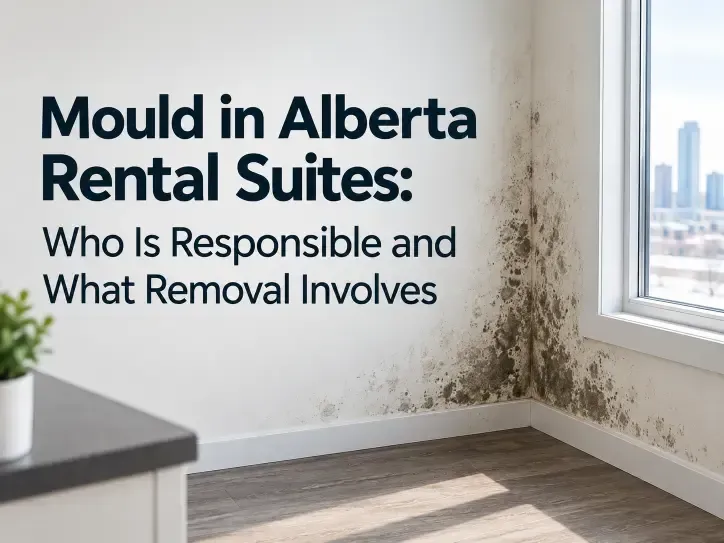
Mould in Alberta Rentals: Who Pays? | Spartan Enhanced
In Alberta, the landlord is responsible for keeping a rental up to the Minimum Housing and Health Standards, and the Centre for Public Legal Education Alberta (CPLEA) says falling below those standards is a breach of the Residential Tenancies Act. When mould comes from a leak, poor ventilation or a building problem, fixing it is on the owner. When a tenant caused it or hid it, the cost picture can change.
The hard part is usually proving which one happened. This guide covers the legal side, what a health inspector can order, why Edmonton suites get mould in the first place, and what a proper cleanup looks like.
Key takeaways
• Landlords must keep rentals at the Minimum Housing and Health Standards. Mould problems usually fall on the owner to fix.
• Tenants should report mould promptly. Staying silent can shift some responsibility to them.
• Alberta Health Services (AHS) can inspect, order repairs and require testing, and the owner must still fix it if the tenant leaves.
• Fixing the moisture source matters more than killing the visible mould.
Is mould the landlord's responsibility in Alberta?
Usually, yes. CPLEA says landlords must maintain rental premises to the Minimum Housing and Health Standards and fix anything that falls below them. The standards don't use the word "mould" much, as CPLEA's LawNow article points out, but they do require building materials and finishes to be kept in good repair.
AHS orders show how this works on the ground. In a September 2026 order for a Medicine Hat suite, an AHS executive officer cited visible surface mould as a breach of section 5(2) of Alberta's Housing Regulation, alongside damaged walls and finishes under the Minimum Housing and Health Standards. In other words, inspectors have clear legal tools even without a mould-specific rule.
Tenants have duties too. CPLEA advises tenants to tell their landlord about mould problems, because a tenant who stays silent may end up sharing responsibility for the damage.
What happens when a tenant calls a health inspector?
AHS Environmental Public Health inspects rental housing on complaint, and it doesn't need the landlord's permission to do so. In a 2022 report, CBC Calgary said AHS data showed 8,007 Albertans had called since the start of the previous year to complain about a rental or request a health inspection.
If an inspector finds problems, AHS can issue an order with deadlines. Two points landlords should know:
AHS says the owner must still fix the issues in the inspection report even if the tenant who complained moves out.
Edmonton orders from 2021 and 2022 required a pre-remediation assessment by an industrial or occupational hygienist approved by AHS, plus air testing that follows the AHS Fungal Air Testing Protocol, before the suite could be reoccupied.
That second point surprises a lot of owners. On a serious case, the job isn't done when the drywall goes back up. It's done when the testing clears.
Why do Edmonton rental suites get mould?
AHS notes that indoor mould grows where there are water leaks, high humidity or condensation. In Edmonton, winter is when all three show up. Warm, moist indoor air hits cold exterior walls, window frames and basement corners, and water collects where you can't see it.
The usual suspects in rental suites:
Bathroom fans that don't work, or that tenants don't run
Condensation on windows and cold exterior walls in winter
Furniture pushed flat against basement walls
Old leaks from plumbing, roofs or ice dams that were patched but never dried
Burst or frozen pipes, especially in vacant suites
Water events are the big one. Our guide to frozen and burst pipes in Edmonton rentals covers the first 24 hours after a leak, which is the window that decides whether you get a drying job or a mould job.
Can a landlord charge the tenant for mould?
Sometimes, but you'll need evidence. A 2023 CBC story about a Cochrane rental shows why. The tenant said she couldn't prove the mould wasn't her fault, and Alberta's tenancy dispute service sided with the landlord.
That case cuts both ways. It shows that tenancy disputes turn on proof, not on who seems more sympathetic. If you want to recover costs from a tenant, you need a clear move-in condition record, photos of fans and windows working, and a record of when the problem was first reported. If you can't show the suite was dry and sound at move-in, assume the cost is yours.
What does proper mould removal involve?
Wiping visible mould with bleach doesn't solve anything if the wall behind it is still wet. A proper job follows a sequence:
Find and fix the moisture source, whether it's a leak, a dead fan or a drainage issue.
Contain the work area so spores don't spread to the rest of the suite or building.
Remove porous materials that are contaminated, such as drywall, insulation, carpet and underlay.
Clean remaining surfaces and run HEPA filtration.
Dry the structure and confirm with moisture readings before closing walls.
Rebuild, and arrange clearance testing if an AHS order or hygienist requires it.
Small surface spots on painted, non-porous surfaces can often be handled in normal cleaning. Mould on drywall, behind baseboards, in carpet or across a large area is a remediation job.
Spartan Enhanced handles water damage, tear-out and rebuild through our restoration services in Edmonton, and documents moisture readings and site photos in the Spartan App so you have a record if the cost is ever disputed.
How to prevent mould between tenancies
Turnover is the best time to catch moisture problems, because the suite is empty and you can see every wall. Add these checks to your turnover list:
Test every bathroom and kitchen fan and confirm it vents outside
Look behind and under furniture spots for staining or soft drywall
Check window sills, frames and the bottom of exterior walls
Take moisture readings on any suspicious spot
Recaulk tubs, showers and sinks
Give new tenants a short note on running fans and managing winter condensation
Then photograph all of it. Those photos are your evidence if mould shows up eight months into the next lease.
Frequently asked questions
Is mould the landlord's responsibility in Alberta?
Generally yes. Landlords must keep rentals at the Minimum Housing and Health Standards, and CPLEA says falling below them breaches the Residential Tenancies Act. If a tenant caused the mould or didn't report it, some responsibility can shift to them, but the landlord needs evidence to show that.
Can a tenant call a health inspector about mould in Alberta?
Yes. Tenants can contact Alberta Health Services Environmental Public Health, which can inspect without the landlord's permission and issue orders. CBC reported in 2022 that more than 8,000 Albertans had called AHS about rentals in under two years. The owner must fix ordered items even if the tenant moves out.
Can a landlord deduct mould cleanup from the security deposit?
Only if the tenant caused the damage beyond normal wear and the landlord can prove it. That usually means a signed move-in inspection report, dated photos and records of when the problem was reported. Without that evidence, a dispute service may not accept the deduction.
Do I need air testing after mould removal?
Not for every job. But AHS orders in Edmonton have required an AHS-approved hygienist assessment before remediation and air testing under the AHS Fungal Air Testing Protocol afterward. If there's an order on the property, read it carefully and plan for testing before reoccupancy.
Found mould in one of your suites?
Book an assessment and we'll find the moisture source, scope the tear-out and give you a documented plan. Call 780-935-9243 or email [email protected].
Sources
Centre for Public Legal Education Alberta, Mould and Rental Properties, retrieved 2026-10-06, https://www.cplea.ca/wp-content/uploads/MouldRentalProperties.pdf
LawNow (CPLEA), Mould and Rental Properties, retrieved 2026-10-06, https://www.lawnow.org/mould-and-rental-properties/
Alberta Health Services, Environmental Public Health order, Medicine Hat (September 2026), retrieved 2026-10-06, https://www.albertahealthservices.ca/assets/wf/eph/wf-eph-sth-804-10-street-se-downstairs-medicine-hat-september-1-2026-a.pdf
Alberta Health Services, Environmental Public Health order, Edmonton (October 2021), retrieved 2026-10-06, https://albertahealthservices.ca/assets/wf/eph/wf-eph-edm-13240-108-street-nw-edmonton-october-18-2021-a.pdf
Alberta Health Services, Environmental Public Health order, Edmonton (November 2022), retrieved 2026-10-06, https://albertahealthservices.ca/assets/wf/eph/wf-eph-edm-13415-102-street-nw-edmonton-november-4-2022-a.pdf
CBC News, When your rental has dirty secrets: renters share tips on calling the health inspector, retrieved 2026-10-06, https://www.cbc.ca/lite/story/1.6629654
CBC News, Calgary-area renter mould tenancy dispute, retrieved 2026-10-06, https://amp.cbc.ca/news/canada/calgary/calgary-renter-mould-tenancy-dispute-1.7025910